
What Happens When a QR Code Is Copied?
QR codes are built to be copied accurately.
That is part of the problem.
A QR code is a visual way to store data. When a phone or scanner reads it, the code usually sends the user to a URL, opens product information, displays a record, or triggers an action.
If someone copies the QR image, the encoded data usually comes with it.
The copy can still scan.
The copy can still redirect.
The copy can still appear valid.
That is why a copied QR code creates a serious problem when the code is being used as proof of authenticity.
The scan works.
The physical object may not be real.
The Problem
A QR code does not know where it is printed.
It does not know whether it is attached to the original product, a counterfeit product, a forged document, or a duplicate label.
It only carries data.
When that data is copied, the copied code can behave like the original.
That may be fine when the QR code opens a menu, a website, or a user manual.
It is not fine when the QR code is being used to verify a product, credential, permit, label, or asset.
In that case, the code is no longer just a connection tool.
It becomes a trust signal.
And copied trust is not verification.
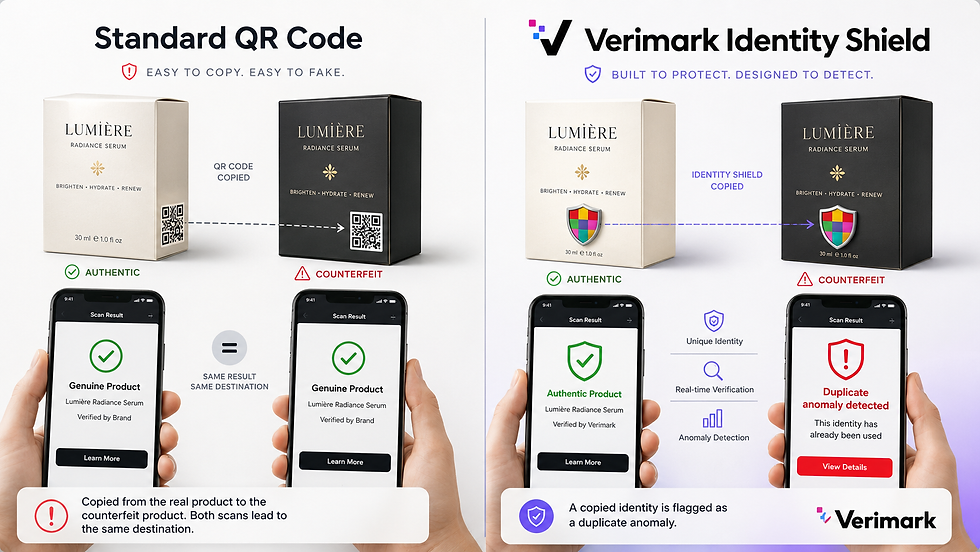
What a Copied QR Code Can Do
A copied QR code can create several failure points.
It can send the user to the correct brand website.
It can display the correct product page.
It can resolve to a real database record.
It can pass a basic scan test.
It can make a fake product appear connected to the real brand.
This is the core weakness.
The system may confirm that the code exists.
It may not confirm that the physical object is authentic.
That difference matters.
Why Serialization Helps, But Does Not Solve the Problem
Serialization gives each product or label a unique identifier.
That is useful.
It allows a system to detect suspicious patterns, such as the same code appearing in two locations or being scanned too many times.
But serialization does not make the QR image impossible to copy.
A valid serialized QR code can still be photographed.
It can still be printed again.
It can still be placed on a counterfeit product.
The system may detect the problem later, after repeated scans or conflicting behavior.
That is useful intelligence.
But it is not the same as preventing the copied code from appearing valid at the point of scan.
Serialization improves visibility.
Verification requires identity resolution.
The Real Question
When a QR code is copied, the important question is not:
Does the copied code still scan?
It probably does.
The real question is: Does the system know that the physical object is not the authorized object?
That is a much higher standard.
Most QR-based systems are not built to answer that question directly.
They can read.
They can redirect.
They can record scan activity.
They can sometimes flag suspicious patterns.
But reading a code is not the same as verifying physical identity.
What a Verification System Must Do Instead
A high-assurance verification system must separate the marker from the authority to trust it.
The marker should not be the source of trust.
The scan should not be treated as proof.
The system must resolve whether the physical item is authorized.
That requires a controlled verification model.
The system needs to know:
Whether the marker structure is valid
Whether the identifier can be resolved
Whether the scan matches expected policy
Whether duplication or misuse is detected
Whether the result should be accepted or rejected
The result must be clear.
Authorized.
Or compromised.
How Verimark Changes the Model
Verimark does not treat the visible marker as the source of trust.
The Verimark Identity Shield functions as a trigger.
It does not expose product data.
It does not display a public URL.
It does not rely on the image itself to carry authority.
When scanned, the decoder evaluates the marker structure and signal quality before identity resolution occurs.
Then a non-meaningful identifier is resolved against the secure system of record.
The system returns a verdict.
Authentic.
Or compromised.
If the marker image is copied, the copy does not become a new trusted identity.
The duplication becomes an anomaly.
That is the difference.
Copying the image does not copy the authority.
Why This Matters for Partners
For brand protection partners, copied QR codes can allow counterfeit products to borrow trust from legitimate brand infrastructure.
For infrastructure platforms, copied identifiers can weaken secure labeling, scanning, and machine-readable workflows.
For government and civic systems, copied permits, inspection markers, or vehicle identifiers can create false authorization in the field.
The risk is not that the code fails.
The risk is that it keeps working after it has been copied.
That is why verification must move beyond readable identifiers.
Final Verdict
When a QR code is copied, the copy can often preserve the original behavior.
It can scan.
It can redirect.
It can appear valid.
That makes QR codes useful for connection, but weak as proof of physical identity.
A verification system must do more than read the code.
It must resolve whether the physical object should be trusted.


Comments