
The Difference Between Detection, Scanning, and Verification
Detection, scanning, and verification are often treated as the same thing.
They are not.
That confusion creates weak security models.
A system may detect a marker.
A user may scan a code.
A platform may open a record.
None of those actions automatically proves that the physical object is authentic.
Verification is a higher standard.
It requires a trust decision.
Detection Means the System Sees Something
Detection is the first step.
It means a camera, scanner, or system has identified that a marker, code, label, or visual pattern is present.
For example:
A camera sees a QR code.
A scanner sees a barcode.
A phone recognizes a visual marker.
An inspection tool identifies a printed symbol.
Detection answers one question:
Is something there?
That is useful.
But it is not verification.
A copied marker can still be detected.
A fake label can still be visible.
A counterfeit product can still carry a scannable code.
Detection proves presence.
It does not prove authenticity.
Scanning Means the User Captures It
Scanning is the action of capturing the marker.
A person points a phone.
A machine reads a label.
A camera captures a visual code.
A scanner extracts data.
Scanning answers a different question:
Can this marker be captured and read?
Again, that is useful.
But scanning alone does not create trust.
A QR code can scan perfectly from a counterfeit product.
A copied serial number can be read clearly.
A fake label can produce a valid-looking response.
The scan worked.
The object may still be compromised.
Verification Means the System Resolves Trust
Verification is the meaningful step.
It answers the question:
Should this physical object be trusted?
Verification requires more than seeing the marker.
It requires more than reading the data.
It requires a system that can resolve identity and return a decision.
That decision may be:
Authorized.
Not authorized.
Authentic.
Compromised.
Valid.
Expired.
The exact language depends on the workflow.
The principle is the same.
Verification produces a verdict.

Why the Distinction Matters
When detection, scanning, and verification are confused, organizations overestimate their security.
They assume:
If the marker is visible, it is valid.
If the code scans, the object is authentic.
If the page opens, the product is real.
If the record exists, the credential is trusted.
Those assumptions fail under copying.
A copied QR code can still be detected.
It can still be scanned.
It can still open the correct page.
But none of that proves the physical object is authorized.
That is the gap.
An Example
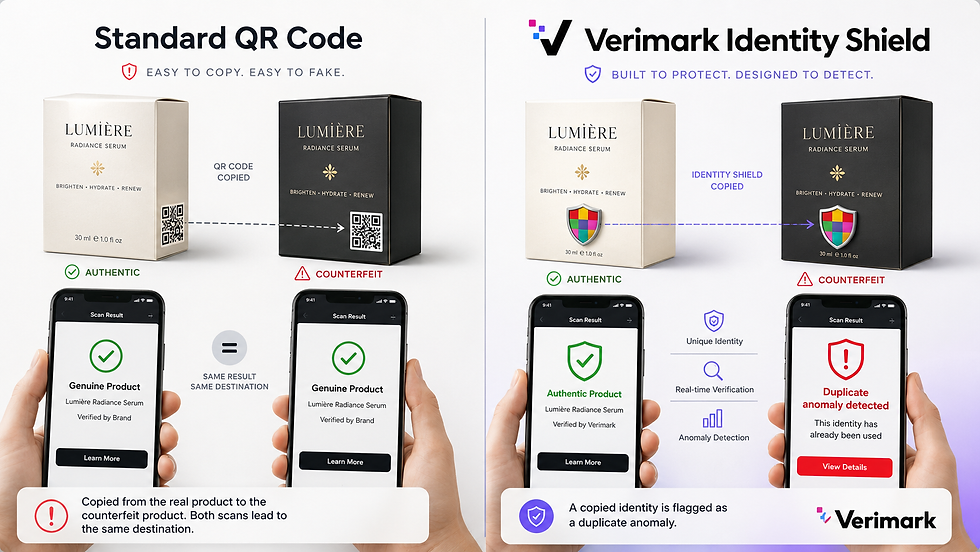
Imagine a luxury product with a QR code on the packaging.
A consumer scans the code.
The phone opens the brand’s verification page.
Everything looks legitimate.
But the QR code was copied from a real product and placed on a counterfeit one.
What happened?
Detection succeeded.
Scanning succeeded.
Redirection succeeded.
Verification failed.
The system confirmed the reference.
It did not prove the object.
What Real Verification Requires
Real verification requires a controlled trust chain.
The marker must initiate the process.
The decoder must validate what was captured.
The system must resolve identity against an authoritative source.
The result must be clear.
The system must also know what to do when something fails.
If the marker is copied, the copy should not become a second trusted identity.
If the signal is weak, the system should not pretend certainty.
If the identifier cannot be resolved, the result should not be treated as valid.
Verification is not just a scan result.
It is governed resolution.
How Verimark Defines the Difference
In Verimark, the scan is only the beginning.
The Identity Shield is detected.
The user or system scans it.
The decoder evaluates the marker.
A non-meaningful identifier is resolved through the secure system of record.
Only then does the system return a verdict.
The Identity Shield itself does not carry trust.
Trust is produced by Verimark’s controlled resolution chain.
That is why detection is not enough.
That is why scanning is not enough.
Verification happens when identity is resolved.
Why This Matters for Partners
For brand protection partners, this distinction prevents a common mistake: treating a successful scan as proof of authenticity.
For infrastructure platforms, it separates machine-readable labels from machine-verifiable identity.
For government and civic systems, it clarifies the difference between a visible credential and a trusted authorization result.
This matters because partners are not buying a better symbol.
They are building a stronger trust model.
The goal is not more scans.
The goal is better decisions.
Final Verdict
Detection means the system sees the marker.
Scanning means the marker is captured.
Verification means the system resolves whether the physical object should be trusted.
These are different steps.
Only one produces authority.
If a system stops at detection or scanning, it has not verified identity.
It has only confirmed that something was readable.
Read the Technical Brief


Comments