
Why Cloned Codes Create Security Blind Spots for Brands
Cloned codes create a dangerous kind of failure.
They make a fake product look connected to a real brand.
That is why they are hard to catch.
A cloned code can scan correctly.
It can open the right page.
It can point to a real product record.
It can pass basic validation.
But the physical product may still be counterfeit.
This is the blind spot.
The system sees the code.
It does not see the substitution.
The Brand Protection Problem
Brand protection is not only about detecting fake packaging.
It is about proving that a physical product is the authorized product.
That distinction matters because counterfeiters do not need to defeat every layer of a brand’s system.
Sometimes they only need to copy the part that creates trust.
A QR code.
A serial number.
A label.
A product page.
A visible security mark.
If the copied identifier still works, the counterfeit product can borrow the appearance of legitimacy.
The brand may not know the difference until damage has already occurred.
How Cloned Codes Hide in Plain Sight
A cloned code can create a false sense of security.
The consumer scans and sees a brand page.
The retailer scans and sees a known identifier.
The system logs a valid scan.
The dashboard shows activity.
Everything appears normal.
But the scan event may be coming from a fake product.
That is why cloned codes are so dangerous.
They do not always create obvious failure.
They create misleading success.

Why Visibility Is Not Enough
Many systems provide visibility.
They show where codes are scanned.
They log scan events.
They record frequency.
They identify patterns.
This is useful.
But visibility is not verification.
A cloned code can still generate visibility.
The system may show that an identifier appeared in a new location, was scanned by a new user, or was activated in a new context.
But unless the system can determine whether the physical object is authentic, it is still analyzing references.
Not resolving identity.
That is a structural gap.
Common Blind Spots for Brands
Cloned codes create several predictable blind spots.
Counterfeit substitution
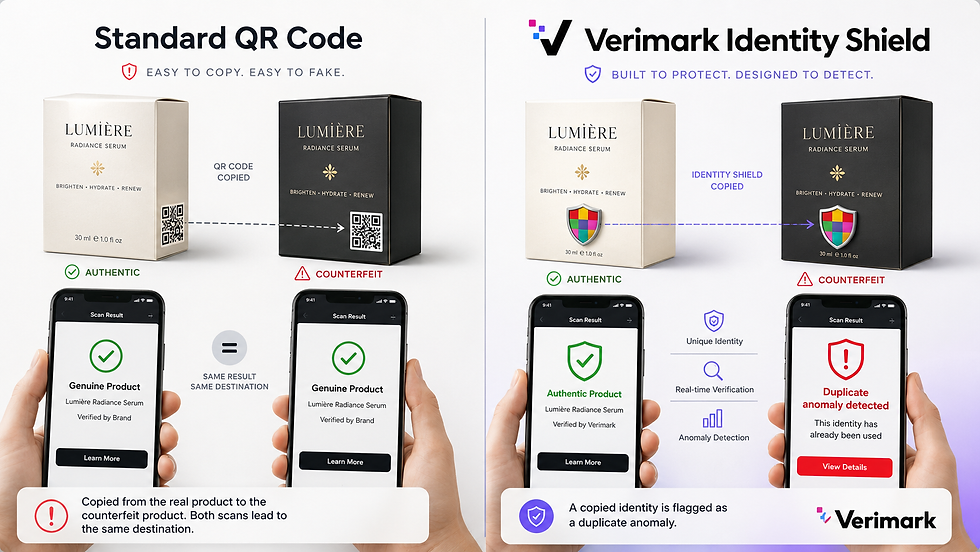
A copied code from a real product is placed on a fake product.
The scan points to legitimate brand infrastructure, giving the consumer false confidence.
Warranty fraud
A valid identifier is reused to claim service, repair, or replacement for a counterfeit or unauthorized product.
Channel abuse
A code appears in places where the product should not be, but the system may not know whether the issue is diversion, duplication, or counterfeit substitution.
Marketplace fraud
Fake products sold online use copied identifiers from real products to appear credible after delivery.
Enforcement delay
The system may only detect the problem after multiple scans, conflicting locations, or repeated complaints.
By then, the brand has already absorbed risk.
Why Cloned Codes Damage Trust
Counterfeiting does more than steal revenue.
It weakens the trust system around the brand.
A consumer who scans a fake product and receives a valid-looking response may blame the brand when the product fails.
A retailer that accepts copied identifiers may unknowingly support counterfeit circulation.
A service center that relies on readable codes may process claims for unauthorized goods.
A brand protection team may see scan activity without seeing the underlying fraud.
This is the cost of cloned codes.
They do not only copy labels.
They copy confidence.
What Brands Need Instead
Brands need identity that cannot be reproduced by copying the image.
That requires a different model.
The system must be able to determine whether the scanned physical item is authorized.
It must detect duplication.
It must expose anomalies.
It must return a clear result.
It must avoid treating a readable identifier as proof.
The question is not:
Does this code exist in the database?
The question is:
Does this physical object resolve as authentic?
That is the standard brand protection now requires.
How Verimark Closes the Blind Spot
Verimark replaces passive visual identifiers with controlled identity resolution.
The Verimark Identity Shield does not expose product data, serial numbers, or a public destination.
It functions as a trigger for verification.
When scanned, the decoder validates the marker’s structure and signal quality.
The system resolves a non-meaningful identifier against the secure system of record.
The result is a verdict.
Authentic.
Or compromised.
If the marker is copied, the copy does not create another trusted identity.
It becomes an anomaly.
That is the key difference.
A cloned code should not produce confidence.
It should produce evidence.
Why This Matters for Partners
Brand protection partners need more than another visible mark.
They need a system that changes what happens when copying occurs.
Infrastructure partners can embed this capability into secure print, labeling, scanning, and packaging platforms.
Government and civic partners can apply the same model to permits, inspections, vehicle identity, and public authorization workflows.
In each case, the value is the same:
Copied identifiers no longer quietly reproduce trust.
They expose risk.
That is the shift from passive protection to active verification.
Final Verdict
Cloned codes create security blind spots because they allow fake products to look connected to real systems.
The code scans.
The page opens.
The record appears.
The trust signal survives.
But the physical product may still be fake.
Brand protection requires more than visibility.
It requires identity resolution.
When copying occurs, the system should not validate the copy.
It should reveal the compromise.
Read the Technical Brief


Comments